Neuroinflammation
Microbes have been implicated in more than infectious diseases; they contribute to conditions such as stomach ulcers, asthma, and cancer. Recent research by Drs. Pier and Cywes-Bentley have explored their role in chronic, inflammation-driven disorders, including traumatic brain injury (TBI), chronic traumatic encephalopathy (CTE), Parkinson’s disease, Alzheimer’s disease, and diabetes. Evidence indicates that microbial fragments or vesicles can lodge in tissues, triggering persistent sterile inflammation and subsequent pathological damage. This represents a paradigm shift in the treatment and prevention of Alzheimer’s disease and other neuroinflammatory conditions broadening the applicability of Alopexx’s therapeutic platform.
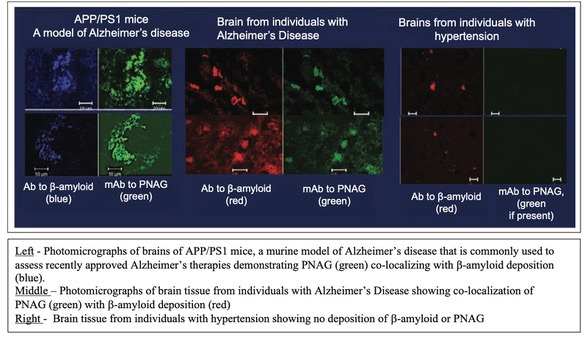
PNAG is absent in mammalian species; its presence in human tissue indicates a microbial origin. Research from the multiple and independent investigators has confirmed that PNAG-containing microbial fragments are present in tissues of patients with Alzheimer’s and Parkinson’s diseases, traumatic brain injury, and diabetes. Because mammals lack enzymes to degrade PNAG, these persistent fragments drive chronic inflammation, contributing to diseases not traditionally associated with microbial infections. As shown in the figure below, PNAG was detected in the brains of individuals with Alzheimer’s disease but not hypertension. PNAG was also noted to co-localize with b-Amyloid and p-Tau whose accumulation in the brain is closely associated with the development and diagnosis of Alzheimer’s disease.
Subsequent preclinical studies in murine models of Alzheimer’s disease demonstrated that Alopexx’s monoclonal antibody F598 and anti-PNAG vaccine AV0328 effectively cleared PNAG-containing fragments. Of significant note and shown below untreated Alzheimer’s mice develop significant cognitive impairment. Treatment with either monoclonal antibody F598 or anti-PNAG vaccine AV0328 restored or normalized cognitive function. These findings suggest that targeting PNAG may prevent or mitigate cognitive decline. This represents a potential paradigm shift in the treatment and prevention of Alzheimer’s disease and other neuroinflammatory conditions broadening the applicability of Alopexx’s therapeutic platform.
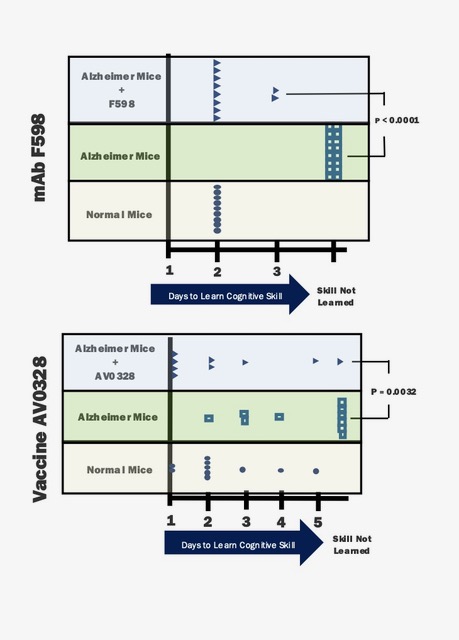
Improvement in cognitive function following treatment of experimental murine Alzheimer's Disease.
The Morris Water Maze test used to test cognitive functions. Most Normal mice were able to learn the cognitive skill in 2 days or less while the Alzheimer mice took considerably longer or were unable to learn the skill. Treatment of Alzheimer mice with mAb F598 or Vaccine F598 was able to mitigate or normalize cognitive function.